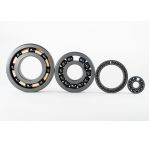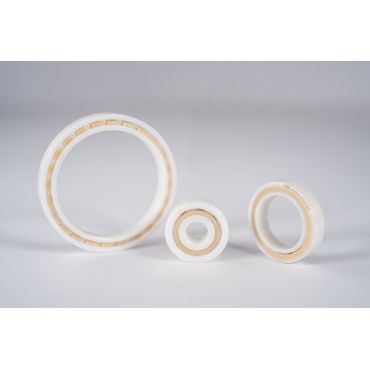
Ceramic ball bearings in zirconium dioxide
Ceramic bearing properties
Ceramic ball bearings play a crucial role in various industries because of their exceptional properties.
Ceramic materials are hard, so they resist wear and deformation, even under heavy loads and high rotational speeds. The hard surface of ceramic bearings reduces surface indentation and rolling contact fatigue. This leads to prolonged bearing life and better reliability.
SMB Bearings supplies ceramic bearings in zirconium dioxide (ZrO2) for shaft sizes from 3mm up to 50mm.
If you’re already confident in your choice, the product tables below provide the needed dimensions and technical drawings.
Please also see our product variants below for Si3N4 ceramic bearing options.
However, if you’re asking yourself, ‘What are the benefits of ceramic bearings?’ continue reading and discover our range.
Full ceramic bearings differ from hybrid ceramic bearings. Hybrid ceramic bearings combine ceramic balls with steel rings, whereas full ceramic bearings use both ceramic balls and ceramic rings. As a result, full ceramic bearings offer superior corrosion resistance and chemical resistance compared to hybrid designs.

Superior strength of ceramic bearings
One of the primary advantages of ceramic bearings is their hardness. ZrO2 is a tough ceramic material with a coefficient of thermal expansion similar to that of steel. This helps maintain shaft and housing fits in higher-temperature applications.
Although often referred to as ZrO2 bearings, they are made from zirconium dioxide stabilised with yttria (yttrium oxide). This air-stable, white solid substance gives the material greater strength and fracture resistance at room temperature. YSZ and YTZP are common terms used to describe yttria-stabilized zirconia ceramics.
ZrO2 cage selection
The cage material used in ZrO2 bearings is crucial for their performance under specific conditions. The ZrO2 full ceramic bearings listed below are available with cages or retainers.
Manufacturers make these cages from polyether ether ketone (PEEK) or polytetrafluoroethylene (PTFE). Bearings with bore sizes from 8mm upwards can also be fitted with 316 stainless steel cages.

In addition, we keep stock of full complement ZrO2 bearings. These bearings have no cage and extra balls. For full complement bearings, the load ratings are approximately 20 per cent higher, but the maximum speed is up to 90 per cent lower.
As for bearings with cages, PEEK cages are usually the preferred choice from SMB Bearings’ stock. This is because of the polymer’s strength and durability. If an alternative cage material is required to cope with particular chemicals or temperature extremes beyond the range of PEEK, these can be produced to order.
Low coefficient of friction
Full ceramic ZrO2 bearings are hard, smooth and, at low speeds, can operate effectively without lubrication, often outperforming steel bearings in these conditions. Applications that need low turning resistance commonly use them unlubricated. Full ceramic bearings have a low coefficient of friction compared to steel bearings. The coefficient of friction for unlubricated ZrO2 bearings is about 0.0012. This applies at ambient temperature in air with a light load.
Lightweight ceramic ball bearings

Another remarkable feature of ZrO2 bearings is their low weight. They are approximately 30 per cent lighter than traditional steel bearings, helping to reduce overall system weight in applications where weight reduction is critical, such as aerospace.
Corrosion and water resistant
ZrO2 bearings are not magnetic or conductive, and they are highly corrosion resistant to most chemicals. They are also extremely water resistant which is why they are often used in marine applications, particularly where the equipment is fully submerged, or where 316 marine grade bearings will not cope with the load or speed. It’s important to note that if ZrO2 has prolonged contact with steam or hot water, there may be some weakening of the material over time.
Temperature tolerance
Full complement ZrO2 bearings, or those with a 316 stainless cage, can be used up to 600 degrees Celsius. As temperatures rise above ambient, decrease loads and speeds. This is especially true if the bearings lack lubrication or at temperatures above 400°C.
Bearings with a PEEK cage are rated up to 250 degrees Celsius due to the lower maximum temperature of the cage material. It may be preferable to use a looser radial play at high temperatures. This especially applies if the inner ring temperature is likely to be greater than the outer ring temperature, as this will reduce the radial play of the bearing. That is why our ZrO2 bearings are supplied with a looser C3 radial play, as standard.
Although PEEK is very durable, it becomes more brittle at low temperatures. Consider PTFE or 316 stainless steel cages for temperatures below -70°C. For a full overview of the pros and cons of ZrO2 bearings, see our ceramic bearing selection guide.

SMB Bearings' ceramic bearings stock
Most of our range of ZrO2 ceramic bearings are supplied from stock in the UK, shipping worldwide. We also supply full ceramic bearings from stock in silicon nitride (Si3N4).
See the product variants below for the Si3N4 versions.
Click on INFO in the rows below to display technical drawings of the bearings with load and speed data. Please note that we use the maximum loads and speeds in theoretical life calculations.
Use bearings well below the maximum load and speed ratings to ensure a long bearing life. For example, ZrO2 full ceramic bearings are best used at low speeds. For high speed applications or continuous rotation over long periods, they will perform better with Si3N4 balls.
Explore our full range of ceramic bearings and helpful resources
Ceramic bearings in Zirconia - Inch
Silicon Nitride ceramic bearings - Inch
Your essential guide to ceramic bearings
Get in touch with our team
Find clear answers to ceramic bearings related questions in our FAQs or contact our experienced team today at sales@smbbearings.com.
Discover the benefits of ZrO2 ceramic ball bearings, including low friction, corrosion resistance and temperature tolerance.