Ball bearing size chart for shaft sizes from 10mm to 30mm
Ball bearings are available in a wide range of sizes and designs, so selecting the correct bearing requires more than matching it to the shaft diameter. Bore diameter, outside diameter, width, load capacity, speed, operating temperature and environmental conditions should all be considered.
This guide covers deep groove popular metric ball bearing sizes for shafts from 10mm to 30mm. Use the size chart below to compare dimensions and access technical drawings, load ratings and speed data.
Deep groove ball bearings
The right ball bearing design depends on the direction and magnitude of the load, operating speed, alignment, available space and required running accuracy.
Deep groove ball bearings are the most widely used type of ball bearing. They can support radial loads and moderate axial loads in both directions, making them suitable for electric motors, pumps, gearboxes, conveyors, fans and many other industrial applications.
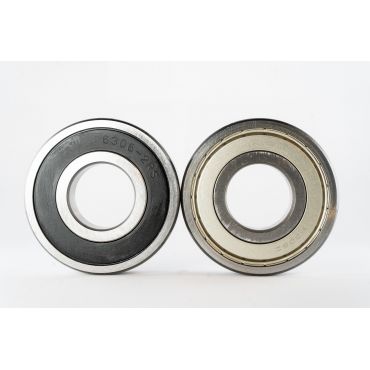
Heavy-duty series such as the 6300 range can support greater loads than lighter series with the same bore diameter. This means two bearings designed for the same shaft size can have very different outside diameters, widths and load capacities.
The popular metric deep groove bearings in this range are manufactured from SAE 52100 (100Cr6) chrome steel, which offers high hardness, good load capacity and low-noise performance.
For applications where low noise and rotational accuracy are particularly important, EZO bearings and P6 low-noise, electric motor quality (EMQ) variants are available in selected sizes.
Understanding metric ball bearing sizes
Accurate measurement is essential when selecting or replacing a ball bearing. The correct dimensions ensure a proper fit, reliable performance and longer service life. Follow the steps below to measure your bearing correctly.
Key dimensions to measure
When measuring a ball bearing, three main dimensions are important:
- Inner diameter (ID or d): The bore size where the shaft fits
- Outer diameter (OD or D): The total diameter of the bearing’s outer ring
- Width (W or B): The overall thickness of the bearing from one side to the other
Bearings are usually specified in the format ID × OD × W.
Tools and preparation
- Use a vernier caliper or digital micrometre for precise measurements
- Ensure the bearing is clean and free from debris, as dirt can affect accuracy
- If the bearing is still installed, remove it carefully or measure through accessible points on the shaft or housing
- Check for a part number. Many bearings have a reference number stamped on the side, which corresponds to their standard size and type
- Check for suffix codes such as C3 or C4, which indicate special internal clearances
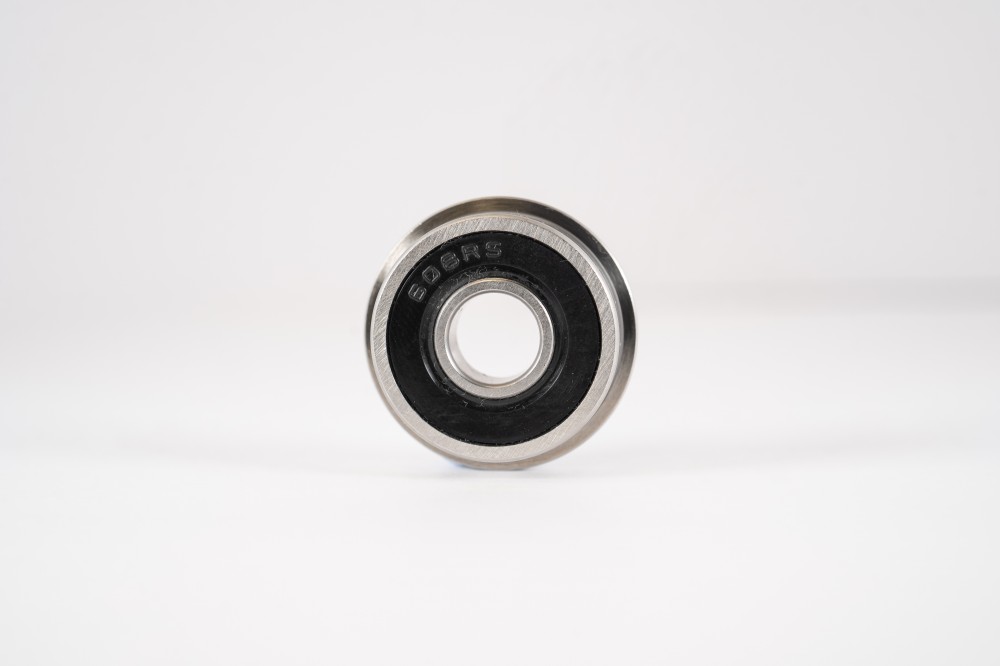
Note any shields or seals (e.g. ZZ, 2RS). Some bearings also have a flange on the outer ring
Why accurate measurement matters
Taking precise measurements ensures the bearing will fit the shaft and housing correctly, maintain the right clearance and operate efficiently. If the measurements are not extremely close to the nearest millimetre, consider that the bearing dimensions may be imperial (inch-sized). There are also a few metric sizes that have a non-standard or imperial ID such as 6205-1”. The bore will measure 25.4mm so accurate measurement will reduce the risk of buying a bearing that doesn’t fit.
SMB Bearings offers a wide range of high-quality metric ball bearings suitable for various applications. Whether you need standard chrome steel bearings or specialised corrosion-resistant or high-temperature bearings, we have the correct bearing solution for you. Explore our product range to find the perfect bearing for your needs.
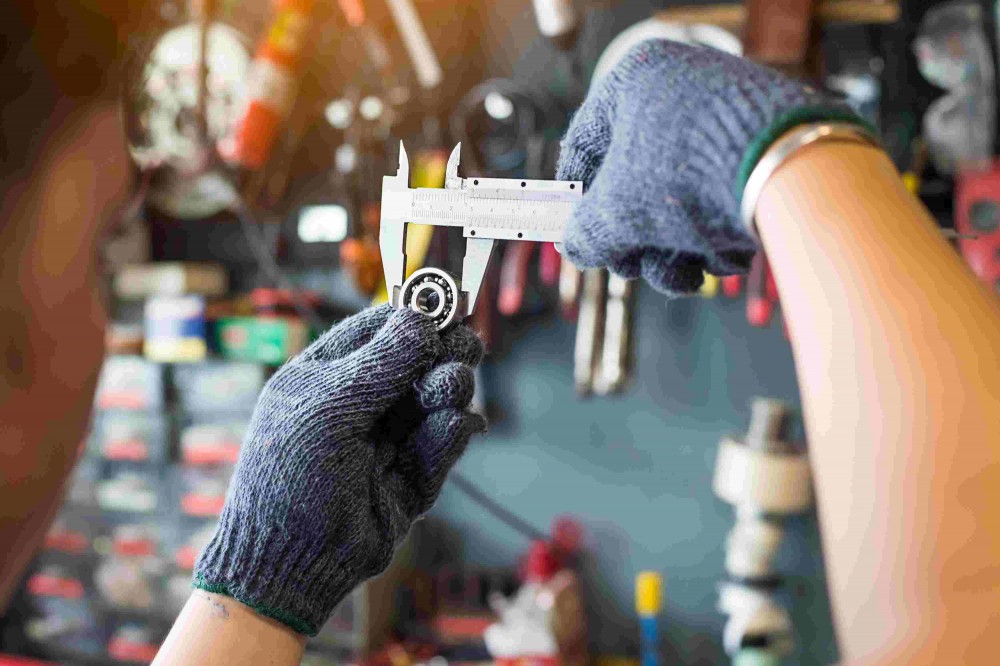
How to measure a ball bearing
A vernier caliper is normally sufficient for identifying standard bearing dimensions, while a micrometre can be used where greater measurement accuracy is required.
Before measuring, clean the bearing to remove dirt or debris that could affect the reading.
1. Measure the bore diameter
Place the internal jaws of the caliper inside the bearing bore and open them until they make even contact with the inner ring. Record the measurement.
This measurement determines the shaft diameter the bearing is designed to fit.
2. Measure the outside diameter
Position the external caliper jaws around the outer ring and close them until they make contact with opposite sides.
Record the outside diameter.
3. Measure the bearing width
Place the caliper across the two faces of the bearing and measure its total width.
You should now have the three measurements needed to identify the bearing in the standard ID × OD × W format.
Check the bearing reference number
Before relying solely on measurements, check whether a bearing reference is stamped or laser-marked on the rings or seals.
The reference can identify the basic bearing size, while suffixes provide additional information about features such as seals, shields and internal clearance.
For example:
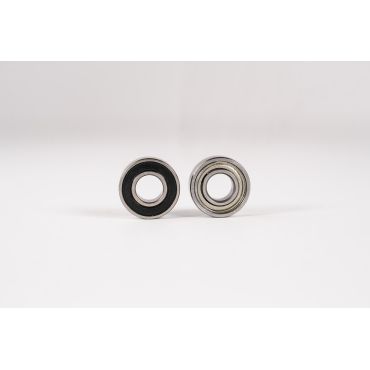
- ZZ or 2Z commonly indicates metal shields on both sides
- 2RS commonly indicates rubber seals on both sides
- C3 or C4 indicates greater-than-normal internal radial clearance
Suffix conventions can vary between manufacturers, so check the manufacturer's specification when identifying an exact replacement.
Choosing a ball bearing by load and speed
Dimensions are only the starting point when selecting a bearing. The bearing must also be suitable for the application's radial load, axial load and rotational speed.
Deep groove ball bearings are a good general-purpose choice where radial loads dominate but some axial load may be present.
The product table below provides load and speed data to help compare individual bearings.
Maximum load and speed ratings should not normally be treated as recommended continuous operating conditions. Operating significantly below maximum ratings can help achieve a more reasonable bearing life, while lubrication, temperature, contamination, alignment and mounting also affect service life.
Material and temperature considerations
Chrome steel is favoured for its high load capacity and cost-effectiveness. These bearing types, equipped with a steel retainer and suitable lubricant, can operate at a constant temperature of 120°C or up to 150°C intermittently.
However, beyond these temperatures, the load capacity of chrome steel decreases. For environments requiring higher temperature resistance or corrosion resistance, alternative materials should be considered.
For high-temperature or corrosive environments, bearings made from materials such as 440 grade stainless steel, marine grade 316 stainless steel, or ceramic are recommended.
Chrome steel bearings are not suitable for use in corrosive environments as they lack corrosion resistance. The standard cage or retainer for these bearings is a two-piece ribbon type made from SPCC steel strip.
Because of the lack of corrosion resistance and temperature limits for this range, different materials should be chosen for very high temperatures or corrosive environments. Fortunately, SMB Bearings stocks corrosion resistant bearings and bearings for extreme temperatures in alternative materials for most sizes listed below such as 440 grade stainless steel, marine grade 316 stainless steel and ceramic.
Open popular metric bearings are supplied with oil lubrication. Shielded or sealed bearings are usually supplied with grease lubrication but shielded bearings can be lubricated with oil for low speed, low friction applications. Thanks to our in-house relubrication facility, open, shielded or sealed bearings can be offered with customer specified oils, greases or dry lubricants.
Ball bearing size chart
Use the product table below to compare popular metric ball bearing sizes for shaft diameters from 10mm to 30mm.
Click INFO alongside each bearing to view its technical drawing, dimensions, load ratings and speed data.
Maximum load and speed specifications are used in theoretical bearing life calculations. For satisfactory service life, bearings should normally operate significantly below their maximum load and speed ratings.
Get in touch with our specialist bearing team today by emailing sales@smbbearings.com or fill in the contact form.
Frequently asked questions
How do I know what size ball bearing I need?
If you are replacing an existing bearing, check its reference number first. You can also measure the inner diameter, outer diameter and width. For a new application, dimensions should be considered alongside load, speed, temperature and operating environment.
Are bearings with the same bore size interchangeable?
Not necessarily. Bearings can share the same bore diameter while having different outside diameters, widths, load capacities and speed ratings. Always check the complete dimensions and technical specification.
What is the difference between sealed and shielded ball bearings?
Metal shields provide contamination protection without contacting the inner ring, helping to maintain lower friction. Rubber seals provide greater protection against moisture and fine contaminants but normally generate more friction.
Can ball bearings support axial loads?
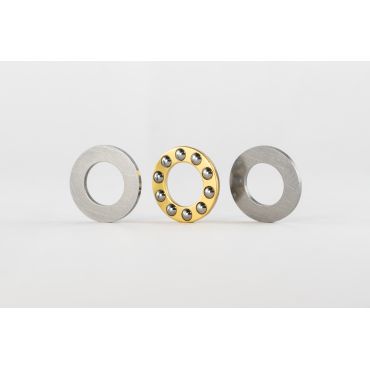
Many ball bearings can support axial loads, but their capacity depends on the bearing design. Deep groove bearings can accommodate moderate axial loads, while angular contact and thrust ball bearings are designed for applications with greater axial loading.
Related technical guidance
- How do I identify a bearing?
- Do ball bearings have temperature limits?
- What is the advantage of a ball bearing without a retainer or cage?
- Can a ball bearing take axial load?
- Can ball bearings conduct electricity?