
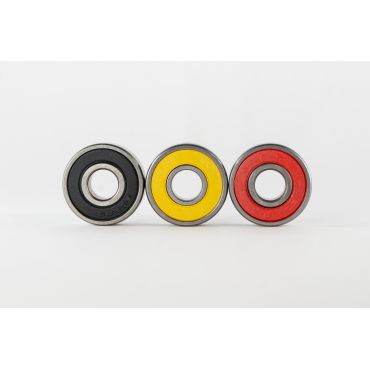
SMB Bearings offers custom designed skate bearings from stock in the UK for skateboards, roller skates, longboards and inline skates.
We have used our extensive knowledge of miniature ball bearings to produce skate bearings to meet even the most demanding specifications. Our two most important design criteria are high performance and value for money. The only difference between our two options is the ball material:
- 608ZZ steel bearings
- 608ZZ hybrid ceramic bearings
When choosing the right skate bearing, key factors include materials, precision, seals, lubrication, cage design and internal clearance.
Material and 22mm ceramic bearings
22mm ceramic bearings are the standard 608 size, designed to fit all regular skateboard wheels.
Rings
SAE52100 chrome steel is the most commonly used steel for bearings thanks to its durability. If you skate in wet conditions, it will corrode, so clean the bearings after use. Stainless steel is slightly softer, but still more than strong enough for skate loads.
Balls
Chrome or stainless steel balls are capable of handling high speeds and heavy loads, making them an excellent choice for most skaters.
Silicon nitride (ceramic) balls are lighter and significantly harder than steel. This reduces friction and running temperature, minimises wear and extends overall bearing life. Ceramic balls are also more resistant to damage from small debris entering the bearing.
However, ceramic balls do not flex like steel. Under sudden impact loads, such as hard landings from jumps, hybrid ceramic bearings are more likely to indent the steel raceways. This can lead to roughness and increased noise over time.
Please note:
- Steel balls = durable and impact-tolerant
- Ceramic balls = lighter, longer-lasting, lower friction
- Best choice depends on your skating style and conditions
Speed ratings
A standard skate bearing has a speed rating of about 34,000 rpm. Our ceramic skate bearings are rated at 48,000 rpm, making them suitable for higher speed applications.
However, with 75mm wheels, the bearings spin under 7,000 rpm at 60 mph (96 kph). So, you will not come close to the maximum speed of a standard bearing.
Precision, noise and torque
Smooth running depends on the roundness and surface finish of the rings and balls. Even microscopic imperfections create vibration and increase torque.
Our skate bearings are EMQ grade, and we select lower-noise P5 precision bearings for improved roundness and smoother raceways. This results in reduced vibration, lower running torque and smoother operation.
Torque (the force required to rotate a bearing) is influenced by:
- Surface finish and roundness
- Seals
- Lubrication
- Cage design
A bearing packed with stiff grease and tight seals will feel harder to spin by hand. However, finger spinning is misleading, as it does not replicate real skate loads. Under load, roundness and surface finish matter more than how long a bearing spins freely in your fingers.
ISO / ABEC Ratings
ISO (metric) and ABEC (inch-based) standards control dimensional accuracy and ring roundness. Higher ratings mean tighter tolerances and improved precision.
They do not control internal looseness, that is determined by bearing clearance.
Seals
Bearings can be supplied with metal shields to keep out larger particles of dirt or rubber seals which will also stop dust.
Metal shields will allow small particles of dirt into the bearing. Contact seals rub on the bearing’s inner ring to create an effective seal. However, they greatly increase bearing drag, which is not ideal for skates.
Seal removal
Non-contact seals can be removed using a thin blade. Use a Stanley knife, trimming knife, or small screwdriver. Carefully slide the tip of the blade between the seal and the inner ring, taking care not to damage the seal.
Push the tip just under the seal, but not too far as you don't want to catch the bearing cage, then gently prise the seal out. The outer lip of the seal sits in a groove in the outer ring of the bearing.
Seal replacement
To refit, press the seal’s outer lip back into the groove in the outer ring. It should snap into place by hand.
Once fitted, check that the bearing rotates smoothly. If it feels stiff, the seal may not be seated correctly.
Non-contact seals offer the best balance. They provide better protection than metal shields without adding noticeable drag. Because they are a push fit into the outer ring, they can be easily removed and refitted for cleaning and re-lubrication.
Lubrication
Proper lubrication prevents overheating and excessive wear inside the bearing. For sealed or shielded skateboard bearings, grease is the most effective option.
Oil can work at low speeds but doesn’t stay in place during higher-speed use. While a low viscosity grease creates more drag than oil, the difference is minimal — especially once the bearing warms up and the grease softens. Grease also helps keep dirt out.
Our skate bearings use a high-speed, low-torque grease from Kluber, a manufacturer trusted in demanding industrial and aerospace applications. It contains durable lithium thickener, more than tough enough for skate use.
Each bearing is filled with a carefully measured amount of grease to balance lubrication and low drag. Grease is also available separately for reapplication.
Removing old lubricant
Old grease or oil can contain abrasive dirt and should be fully removed before re-lubricating.
Soak the bearing in a suitable solvent (such as white spirit) and agitate or spin it to loosen debris. Once clean, spin out excess solvent and allow the bearing to dry completely on a clean surface.
Always follow safety instructions. Never use petrol, and keep flammable solvents away from ignition sources.
Ensure the bearing is fully dry before re-greasing, as residual solvent will degrade new lubricant.
Applying grease
Without specialist equipment, re-greasing requires estimation. Aim to fill approximately 15 to 20 per cent of the bearing’s internal space.
Apply small amounts evenly between the balls and into the raceways. Once complete, rotate the bearing several times by hand to distribute the grease.
To protect against corrosion, apply a light oil coating to outer surfaces of chrome steel bearings (e.g. 3 in 1).
Cage and retainer
A good all-purpose steel cage is sufficient for skate bearings. We use a high-speed nylon cage which has better sliding characteristics and slightly lower noise. It is also more forgiving if dirt gets into the bearing, or if lubrication is inadequate.
This matters if your bearings are overdue for cleaning and re-lubrication. The stainless bearings have a stainless steel cage.
Clearance
The internal clearance of the bearing relates to the space between the balls and the raceways. Designers make a bearing to take mainly radial load (vertical load on skate bearings) and some axial (side) load. The clearance on our skate bearings is slightly larger than standard. It is designed to handle greater side loads when needed.
Cleaning and re-greasing
To make bearings last longer, they should be kept clean. In skate conditions the bearings are often subjected to dirt and dust. To cut costs, carry out regular maintenance to remove dirt from inside the bearing and replace contaminated grease.
Note that dirt in the bearing usually means damage to the surface of the balls and raceways. Cleaning skateboard bearings will not restore them to their original state. But it can prevent further damage, until more dirt gets in.
Checking for wear
Checking your skate bearings for wear is simple. Over a period of use, wear will cause flaking and fine particles of metal will break away. You may have dented the bearing raceways by performing jumps, increasing roughness in the bearing.
At this point the wear will accelerate as metal debris score and dent the balls and raceways. Any dirt that has worked its way into the bearing will speed up this process. To check for wear, hold the bearing's inner ring between a thumb and finger and then turn the outer ring with your other hand. If the bearing is worn, you will be able to feel roughness or grittiness.
If the roughness is still there after cleaning, the bearing is due for replacement. Worn bearings often feel rougher after cleaning because grease has a dampening effect.
Contact our bearing experts
To purchase SMB skate bearings and skate bearing grease, contact the SMB Bearings team at sales@smbbearings.com.