
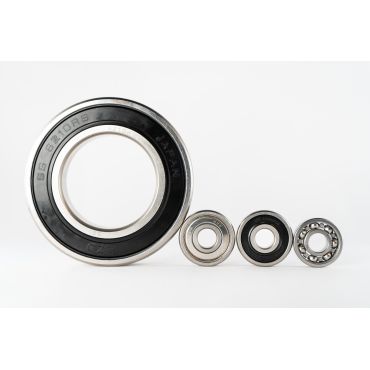
Stainless steel bearings for shafts from 10mm to 50 mm diameter
Stainless steel ball bearings for wet, corrosive, washdown and high-temperature applications, available from stock in the UK.
See the product table below for dimensions, load, speed ratings and technical drawings.
Stainless steel bearings for demanding environments
Our larger stainless steel bearings, suitable for shaft diameters from 10 mm to 50 mm, are designed for applications where standard chrome steel bearings may be vulnerable to moisture or corrosion.
They are suitable for medium to high loads and speeds and are commonly used in wet or frequently washed-down equipment.
Typical applications include food and beverage processing, packaging machinery and other industrial equipment exposed to moisture or mildly corrosive conditions.
For smaller shaft diameters, see our range of stainless steel miniature bearings.
440C and KS440 stainless steel bearings
The bearings in this range are manufactured from AISI 440C stainless steel, which combines corrosion resistance with the hardness required for higher load and speed capabilities.
EZO stainless steel bearings use rings manufactured from KS440 (ACD34/X65Cr13), a stainless steel grade offering improved noise levels and wear resistance compared with standard 440C.
Stainless steel shields and retainers are generally manufactured from AISI-304 stainless steel, although selected sizes are available with reinforced polyamide retainers.
Seals, shields and lubrication options
Bearing specification can be adapted to suit the operating environment. Sizes are available with stainless steel shields or rubber contact seals, while selected bearings can also be supplied with chemically resistant, high-temperature Viton seals.
We can also supply stainless steel bearings with specialist lubricants, including:
- Food-grade lubricants for food and beverage machinery
- Water-resistant lubricants for wet and washdown environments
- Chemically resistant lubricants
- High-temperature lubricants for applications up to 300°C, subject to the bearing specification
- Vacuum-compatible greases for vacuum applications
- Dry lubricants including molybdenum disulphide and tungsten disulphide for suitable low-speed applications
For some low-speed applications, bearings can also be supplied without conventional grease or oil lubrication.
When should you choose 316 stainless steel bearings?
AISI 440C stainless steel offers good corrosion resistance, but it can still be affected by seawater, strong acids and strong alkalis.
Where corrosion resistance is more important than load or speed capability,
316 grade stainless steel bearings may be more suitable. For highly corrosive environments with low loads and speeds, consider our plastic bearings.
Where greater corrosion resistance is required alongside higher load and speed capabilities, full ceramic bearings may provide a better alternative.
Choosing the right stainless steel bearing
Bearing life depends on more than bore size. Load, speed, temperature, contamination, exposure to water or chemicals, lubrication and sealing requirements should all be considered when selecting a bearing.
Click INFO in the product table below to view technical drawings together with load and speed data for each bearing.
The load ratings shown apply to AISI 440C stainless steel bearings. EZO KS440 bearings have higher load ratings. Maximum load and speed figures are used for theoretical life calculations and should not normally be treated as recommended continuous operating limits.
Frequently asked questions
What is the difference between 440C and 316 stainless steel bearings?
440C stainless steel can be thermally hardened to provide considerably better load and speed capabilities, while 316 stainless steel offers greater corrosion resistance but is much softer. The right choice depends on whether mechanical performance or corrosion resistance is the greater priority.
Can stainless steel bearings rust?
Yes. Stainless steel is resistant to corrosion rather than completely corrosion proof. 440C bearings can corrode when exposed to seawater, strong chemicals or particularly aggressive environments.
Are stainless steel bearings suitable for the food and beverage industry?
Stainless steel bearings are widely used in food processing and packaging equipment, particularly where machinery is exposed to moisture or regular washdowns. Bearings can also be supplied with food-grade lubricants where required.
What information do I need to select a stainless steel bearing?
Start with the required bore or shaft diameter, then consider radial and axial loads, rotational speed, operating temperature, exposure to water or chemicals, sealing requirements and lubricant requirements.
Additional information and support
Need help choosing a bearing? Tell us your shaft diameter, load, speed, operating temperature and environmental conditions and our technical team can help identify the most suitable stainless steel bearing for your application.
Get in touch with our experienced team today by emailing sales@smbbearings.com or fill in the contact form for guidance on selecting the right bearing for your application.